
The TcxLocalizer component helps you localize those of your applications that use our controls, as well as third-party or standard controls. This component provides centralized control over an application’s UI language or locale. Using this component, switching to another locale is as simple as changing a single option.
http://community.devexpress.com/blogs/ctodx/archive/2008/10/31/vcl-subscription-new-localization-tool-coming-in-next-build.aspx
Saturday, November 01, 2008

Thursday, October 30, 2008
Things that make you go humble – update
Please go to the blog again to see two videos on SecondLight and on Boku. Really worth the time they take.
Things that make you go very humble
Bye,
Bart
Wednesday, October 29, 2008
Things that make you go very humble
Todays keynote was exceptional. The topics were coming from Microsoft Research and although the first half hour or so was full of stuff mentioning how important Microsoft Research is to Microsoft and to the world, the remainder of the presentation was unbelievable good.
Sorry about the lack of pictures and videos this time; I didn’t have the camera ready. Sorry. The most cool stuff is at the end of the article so keep reading.
Keep reading to read about SecondLight
There was a talk about how MSR works in the field of medicine, helping researchers analyzing fast amounts of data. And although you really got the point that Microsoft’s technology is helping in that field, it didn’t feel really special.
There also was a talk about very tiny measuring devices for temperature and humidity and things like that, that are actually installed at the convention centre. The devices itself use about 4K of memory (remember that from the old days?) and only have a circuit board that’s the size of a quarter coin. It has a radio transmitter and, to give you a sense of things, there are about 100 of those sensors installed in the main hall. Microsoft has gathered the data about temperature and such during the last couple of days and presents the (vast amount of) data in nice graphical form. It really showed how the cooling system works and what the impact of the equipment, audience, and the cooling system is to the conditions in the hall.
Next, a new programming language for kids, called Boku, was shown. It uses a XBox console to let kids program a ‘games world’ and do really fantastic cool stuff using iconized commands. The speaker spoke quicker than a rapid firing machine gun, but what he showed was really AWESOME and I want one of those for my kids! This will be a very good reason for me to by an XBox (not quite sure if it was a PC or XBox that was used). Go look up the videos on Boku that are probably out there. It really was amazing to watch.
But, the real highlight of the key note was the stuff on what Microsoft calls SecondLight. Really DO GO find videos on that. It comes down to this. It uses a special kind of LCD and infrared cameras. The LCD can be made transparent by applying some kind of current to the screen.The effect is that the LCD will not only display the images as you know, but also lets a second image go through, to be projected on a simple piece of paper. And the fun thing is: this second image can be totally different from the image that is shown on the LCD. The effect is that you can display secondary information about (pieces of) the image on the primary LCD. (Side note: I just hear a fellow programmer calling home about this and he calls it “Freaking Cool”). You can hold a piece of simple paper just above the screen and show some detail information about the stuff that’s under that.
I find it hard to express in words, but really, really, go find videos and other information on this. It is freaking cool.
It really made me ponder about my own work. What a amazing boring job I have! I want to be working for Microsoft Research!
Bye,
Bart
Windows 7 installed
 I installed the pre-beta Windows 7 that we got. About the Windows 7 client itself: it looks a lot like Vista but has a couple of nice new things. You will find others blogging about all the new things found in there, so I won’t.
But, here’s a little tip. It runs excellently in a Sun’s VirtualBox box. Just point to http://www.virtualbox.org to get your copy and try it. I got it up and running within the hour without a hitch and that’s on a good but not very modern portable. VirtualBox feels a lot faster than Virtual PC. I will need Virtual PC though, because the Visual Studio 2010 copy that we got is made available as a VirtualPC image.
The goodies are delivered on a very nice and small 150Gb hard disk that I probably keep using because of its physical size. It’s nice and small yet very useful.
I also got to shake hands finally with Nick Hodges, Allen Bauer, Marc Hoffman and Jim McKeeth. My Dutch accent prevents me from taking part in the little interview that Jim did (I’m just too embarrassed), but I will definitely listen to it when it’s online.
We are getting ready to go to the party at the universal Studios now. And some people were already getting ready for that :-)
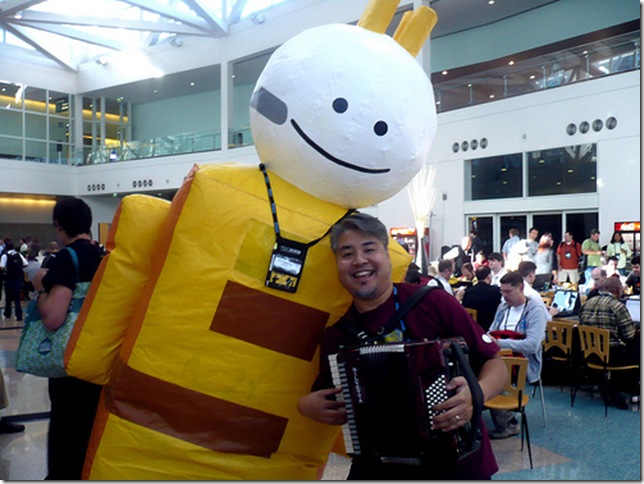
Bye,
Bart
Tuesday, October 28, 2008
Presentation on Azure/Live/Mesh on the PDC
I just watch a presentation on the PDC on MS Azure and Windows Live by Chris Anderson and Don Box. These guys had a great presentation prepared and it was pretty fun to watch. They showed a bunch of great techniques and demo-ed how Azure will host your stuff (applications and data alike). They also showed how easy it is to get something going with techniques and languages that we already know like C#, LinQ, et cetera. In my mind it shows the counter part to the Google Apps platform (and probably beyond that).
However, they hardly got any applause which I think was very funny in itself. Although the stuff they showed was excellent and pretty ground breaking. Now, why didn’t they got the applause that they were quite obviously expecting?
A couple of reasons are possible:
- The audience didn’t get it. Nah, there are a couple of thousand developers in the audience and probably all very smart programming on a day to day basis. That can’t be it.
- The stuff isn’t that special and people thinking: what’s so special about that? That can be it, but that would probably because the stuff is so easy to do. From within Visual Studio and with a couple of easy mouse clicks you can deploy your software out there and the same goes for your data.
- Now, the third reason might be it (and it is the reason why I didn’t clap my hands a lot). This is ground breaking stuff that gives companies and developers a lot of power to create new solutions quickly and much faster than before. But, would you trust your applications and data in the hands of Microsoft?
I think that for applications that provide public services, like route finding applications, this all is great stuff. You can very quickly create your app, deploy it out there in the cloud for others to use. However for you business application you would like to keep your stuff on your own machines.
Now, what was shown in the demo, and maybe wasn’t emphasized enough, is the lack of needing to know where stuff is. It might be in the clouds or on your own machines, it might be in an Azure SQL Server database or in your own: it doesn’t matter. Simply by changing a root URI you can use the stuff from where ever it is.
So far I think Azure and the like is great stuff and I will certainly be thinking on how to use it. It is just not clear to me yet how I can use it in our software (which creates documentation solutions). But, maybe I should give myself a bit of time to think about that.
Bye,
Bart
Summary of my first day at the PDC
After a wonderful Sunday at Venice beach, having a beer and fish and chips at a Irish pub, the jet lag hit us and we had a hard time staying awake. It made us miss one of the parties of the PDC, but after all, we are here for work, aren’t we?
So this morning we got up at 6:30 AM but still didn’t make it to the start of the key note speech on Monday. But, when we got there, I felt we hadn’t missed much. Key note speeches don’t make a successful conference. We sat it out, but next time, I will leave early if the speeches are that boring.
I attended a (what turned out to be) basic demonstration of Sharepoint and having learned my lesson at the key note speech I did leave that early this time.
I visited the CodeGear booth, got a t-shirt, and was told the Prism DVD doesn’t have anything that I don’t already have. I got to speak to my family using Skype (which was a first to me) and was able to kiss my son to sleep which was a great bonus.
 I had a chance to catch up with the ‘Partner manager’ for MS Surface and later attended a presentation on MS Surface. And to me, that was the absolute top of the Monday. The presentation was pretty funny, and the stuff the guys showed was really awesome. If you never had your hands on a MS Surface table: try to do so. It’s a fun and exciting experience.
The presentation showed what Microsoft has done to make the life of the developer easier and it appears they have done an excellent job on that. It is amazing to see how good the assembly for using the MS Surface library matches the things you know already about programming in the modern MS languages. It’s looks to be very easy to sit down and write your first Surface program.
And if you were there, you will get the Surface SDK and you can do so. And I for one will definitely will, because I have some great ideas for it. I will also try to use it from Prism (no reason why we couldn’t). I will let you know the results when doing so…
Bye,
Bart
Wednesday, October 15, 2008
Visiting the Microsoft PDC
We've just decided that I will be visiting the Microsoft PDC. That is, if there are any tickets, hotels and flights still available :-
I'm sure I will have a peep at the place where Prism will be available. Since I am always on the look out for new technology, and looking for opportunities to move our software to the .Net platform, I will definitely want to have a look at Codegear's product in that market. I really hope to get my hands on a trial version and/or have a close look to see why I would choose for Prism and not for C#.
Also, I'm pretty interested in Windows 7. So, that I will give that a close look too (and maybe even try our software on it).
If any of you want to schedule a meeting or demo of our Sevensteps Studio product or any other Sevensteps software product, please let me know and we'll schedule a meeting. I'm always on the look out for new business partners to setup a new product. If you want to get first hand knowledge about what our software can do for you, this might be a right time.
Cu in LA.
Bye,
Bart
I'm sure I will have a peep at the place where Prism will be available. Since I am always on the look out for new technology, and looking for opportunities to move our software to the .Net platform, I will definitely want to have a look at Codegear's product in that market. I really hope to get my hands on a trial version and/or have a close look to see why I would choose for Prism and not for C#.
Also, I'm pretty interested in Windows 7. So, that I will give that a close look too (and maybe even try our software on it).
If any of you want to schedule a meeting or demo of our Sevensteps Studio product or any other Sevensteps software product, please let me know and we'll schedule a meeting. I'm always on the look out for new business partners to setup a new product. If you want to get first hand knowledge about what our software can do for you, this might be a right time.
Cu in LA.
Bye,
Bart
Thursday, September 25, 2008
DevExpress releases beta for controls supporting D2009
Well, I just got that email that I was waiting for. DevExpress has its first (beta) release out supporting D2009. I now have placed my order for D2009. I hope everything works out as smooth as you read out elsewhere. And it looks like I can finally get my feet wet with regards to the anonymous methods, so I will know better what I’m talking and complaining about.
When I’ve set everything up I will definitely publish my experiences…
Bye,
Bart
Wednesday, September 24, 2008
Proof of the concept is in the eating...
Marco published a little example of anonymous methods. I already commented about it on his blog, but to me this is the very proof of the uglyness of anonymous methods.
To me the beauty in object oriented languages is the ability to create easy readable code if you take care of your object design and naming conventions. If you have a sound object model and you choose the names of properties and methods wisely, your code will be very easy to read and to understand. If you keep you code logic simple and short (I very much favor methods and functions that have a very limited amount of code in them) no one will have trouble reading (and if necessary maintaining) your code.
Marco's example, to me, proofs that anonymous methods are terrible. One has to read his little piece of code a couple of times to see what's going on and still it would probably need a bit of documentation. Or, maybe it's me, and only I have to read his code a couple of times.
In my book the anonymous methods will remain very much what their name suggests: not very well known.
Bye,
Bart
To me the beauty in object oriented languages is the ability to create easy readable code if you take care of your object design and naming conventions. If you have a sound object model and you choose the names of properties and methods wisely, your code will be very easy to read and to understand. If you keep you code logic simple and short (I very much favor methods and functions that have a very limited amount of code in them) no one will have trouble reading (and if necessary maintaining) your code.
Marco's example, to me, proofs that anonymous methods are terrible. One has to read his little piece of code a couple of times to see what's going on and still it would probably need a bit of documentation. Or, maybe it's me, and only I have to read his code a couple of times.
In my book the anonymous methods will remain very much what their name suggests: not very well known.
Bye,
Bart
Saturday, September 06, 2008
AutomatedQA know their support
Some time ago I reported serious problems that prevented me from compiling my projects using AutomatedBuildStudio from Automated QA. I already had some support emails going back and forth but the solutions was nowhere near.
So, I decided to switch to FinalBuilder and installed the trial version. That was a good experience and it got me going with my projects in a half a day.
I still was in contact with AutomatedQA though and they asked an opportunity to try to solve the problem. I gave them the length of the trial period of FinalBuilder (which is a month). To make a long story short: I ended up letting an AutomatedQA programmer take over my developers computer (using the ever excellent TeamViewer) and after an hour or so fiddling with configuration files, temporary files during the build, et cetera, they concluded to have found an offending compiler setting generating during the build process.
They promissed a solution by the next day and they delivered that. Compiling my projects works fine again.
That makes me happy for a couple of things:
1) Apparently the problems of a single use does mean a thing to AutomatedQA. They could have said: sorry we lost you, but there's nothing we can do. They didn't do that and really digged in.
2) I discovered a problem with FinalBuilder and Wise v6 in creating installer packages. After a compilation of the Wise package from Finaler Builder, the Wise project is damaged and from that point on unusable. I had to compiling my packages 'by hand' which was pretty unconvenient. I'm sure I would have found some sort of automated build process if I had to stick with FinalBuilder, but it wasn't as problem free as I first thought.
Most important of all, I can still use my original build scripts, which are pretty advanced and saved me a lot of time in the past and now probably will do in the future.
Just to let you know and to do justice to the support team of AutomatedQA. It just tells me again that having great support pays off in the end to both parties.
Bye,
Bart
So, I decided to switch to FinalBuilder and installed the trial version. That was a good experience and it got me going with my projects in a half a day.
I still was in contact with AutomatedQA though and they asked an opportunity to try to solve the problem. I gave them the length of the trial period of FinalBuilder (which is a month). To make a long story short: I ended up letting an AutomatedQA programmer take over my developers computer (using the ever excellent TeamViewer) and after an hour or so fiddling with configuration files, temporary files during the build, et cetera, they concluded to have found an offending compiler setting generating during the build process.
They promissed a solution by the next day and they delivered that. Compiling my projects works fine again.
That makes me happy for a couple of things:
1) Apparently the problems of a single use does mean a thing to AutomatedQA. They could have said: sorry we lost you, but there's nothing we can do. They didn't do that and really digged in.
2) I discovered a problem with FinalBuilder and Wise v6 in creating installer packages. After a compilation of the Wise package from Finaler Builder, the Wise project is damaged and from that point on unusable. I had to compiling my packages 'by hand' which was pretty unconvenient. I'm sure I would have found some sort of automated build process if I had to stick with FinalBuilder, but it wasn't as problem free as I first thought.
Most important of all, I can still use my original build scripts, which are pretty advanced and saved me a lot of time in the past and now probably will do in the future.
Just to let you know and to do justice to the support team of AutomatedQA. It just tells me again that having great support pays off in the end to both parties.
Bye,
Bart
Friday, August 29, 2008
To further on all the non(sense) news about Tiburon...
I may be too sceptical, under too much work stress, or maybe I'm catching some flew or the other. But really, is the news about the handling of a password character worth the bits over the internet? (oops, now I've done it myself).
See: http://glooscapsoftware.blogspot.com/2008/08/delphi-2009-passwordchar.html
Come on everybody out there. I love to read about generics and implementation (problems) with the Unicode stuff. I even find the reports about the installation time more worthwhile than this.
It's probably me... Lunch time is over: back to business!
Bye,
Bart
See: http://glooscapsoftware.blogspot.com/2008/08/delphi-2009-passwordchar.html
Come on everybody out there. I love to read about generics and implementation (problems) with the Unicode stuff. I even find the reports about the installation time more worthwhile than this.
It's probably me... Lunch time is over: back to business!
Bye,
Bart
Wednesday, August 27, 2008
So, installation time is shorter. Who cares????
I've now seen a couple of blogs about the improved install speed of the new Delphi version. It may be me, but I really don't get it why people get so enthousiastic about that. Who cares if your installation takes 10, 20 or 60 minutes? It's something that you (should) do only once in a long while and then you're done with that. I much rather see 10% improvement in compile speed than 1000% improvement in installation time.
Am I crazy or what? Let's state it once again and never mention it after this:
installation time of Delphi 2009 has improved!
(now, back to work...)
Bye,
Bart
Am I crazy or what? Let's state it once again and never mention it after this:
installation time of Delphi 2009 has improved!
(now, back to work...)
Bye,
Bart
Tuesday, August 26, 2008
Would you buy Delphi 2009?
Now the new version is in the open I found me talking to myself yesterday (...) about when and why I should buy the new version. I am curious enough to want to get my hands on it, but really haven't found an argument for upgrading yet. The new features in the language are not the ones that will solve all my remaining whishes for my software. I am using DevExpress components and not using ribbon toolbars (yet), so there's not a lot of new things in the VCL for me.
I do want unicode though, badly, so that is a good reason. But I'm using the DevExpress components so I need to wait for those to be 2009-ready. So, I have decided to wait for them to come with a unicode compatible release of their components before buying 2009. Since everybody says that implementing unicode with 2009 is so easy, it shouldn't take long, but I'm not really sure about that to be honest. We'll see...
What about you? Can you control yourself and find a decent reason to upgrade? Or are you susceptible for the hype-like messages about 2009 and find you running to the shop already?
Bye,
Bart
I do want unicode though, badly, so that is a good reason. But I'm using the DevExpress components so I need to wait for those to be 2009-ready. So, I have decided to wait for them to come with a unicode compatible release of their components before buying 2009. Since everybody says that implementing unicode with 2009 is so easy, it shouldn't take long, but I'm not really sure about that to be honest. We'll see...
What about you? Can you control yourself and find a decent reason to upgrade? Or are you susceptible for the hype-like messages about 2009 and find you running to the shop already?
Bye,
Bart
Monday, August 11, 2008
Exceptions, return value checking, pre- and postconditions
I never actually worked with Eiffel but when I first heard about it (that is some decades ago, really...) there is one concept that I remembered for the whole of my professional career and I adhered as a 'coding principle' in my own code. I'm talking about the concept of pre- and postconditions.
As I remember it in Eiffel you can write your method/function/procedure (whatever it's called) and define some conditions that must be met before and at the end of that. E.g. you could define a precondition for a function that will ensure that a passed parameter is larger than zero. For the remainder of your code you can assume that the passed parameter IS larger than zero.
Now, whenever I write a function/method I do the same. E.g. if I do a typecast somewhere in my code, I try to check for the correctness of the object that is typecast as soon as possible in my code. Something like this (from the top of my head, forgive me typos, simplicity of the examples and such):
procedure Foo(const aControl: TWinControl);
begin
// Beginning of preconditions
if not Assigned(aControl) then exit;
if not (aControl is TEdit) then exit;
// End of preconditions
// You can now safely execute the code below
TEdit(aControl).Text := 'foo';
end;
The above works fine if there actually is something that you can check at the beginning of the code. But, what if you cannot, until right before you start to use an object? Like below:
procedure Foo();
var
aControl: TEdit;
begin
(**
A Whole Bunch of Code Here
**)
aControl := MyFunctionSomeWhereThatReturnsTEdit();
if (not Assigned(aControl)) then exit;
if (not (aControl is TEdit)) then exit;
aControl.Text := 'foo';
end;
In this case you would add your check just below the aControl := line. And if you have a lot of those, your code can become complex and hard to read. And you would end up with a lot of not so interesting code which in the end doesn't really matter to your program.
Now, until now I used assertions for this type of checking, mainly because you can turn those off easily using a compiler switch.
aControl := MyFunctionSomeWhereThatReturnsTEdit();
Assert(Assigned(aControl));
Assert(aControl is TEdit);
But, of course, this doesn't work if the 'failing conditions' might be ligitimate circumstances in your code. So, for those types of checks I used the if..then constructions from the first example.
But, I am now thinking that I'd better use exceptions for this. Currenlty I only use exceptions for 'error circumstances' and never really used them as a way to signal pre- and postconditions. It would go like this:
procedure Foo();
var
aControl: TEdit;
begin
try
(**
A Whole Bunch of Code Here
**)
aControl := MyFunctionSomeWhereThatReturnsTEdit();
aControl.Text := 'foo';
except
on E: MyConditionException do
begin
// This will be an exception raised from within MyFunctionSomeWhereThatReturnsTEdit
end;
on E: Exception do // There probably are seperate exceptions for nil and class type mismatch exceptions, but this will do for the example
begin
// Something else should be done.
end;
end;
end;
This will work (and I think I will give it a go in some small program to see if it works our for my style of programming), but I'd much rather see the concept of pre- and postconditions introduced in Delphi.
What do you think? If..Then constructions at the beginning? Exceptions? Push Embarcadero for pre-/postconditions? Something else?
Please let me know; I'm really curious.
Bye,
Bart
As I remember it in Eiffel you can write your method/function/procedure (whatever it's called) and define some conditions that must be met before and at the end of that. E.g. you could define a precondition for a function that will ensure that a passed parameter is larger than zero. For the remainder of your code you can assume that the passed parameter IS larger than zero.
Now, whenever I write a function/method I do the same. E.g. if I do a typecast somewhere in my code, I try to check for the correctness of the object that is typecast as soon as possible in my code. Something like this (from the top of my head, forgive me typos, simplicity of the examples and such):
procedure Foo(const aControl: TWinControl);
begin
// Beginning of preconditions
if not Assigned(aControl) then exit;
if not (aControl is TEdit) then exit;
// End of preconditions
// You can now safely execute the code below
TEdit(aControl).Text := 'foo';
end;
The above works fine if there actually is something that you can check at the beginning of the code. But, what if you cannot, until right before you start to use an object? Like below:
procedure Foo();
var
aControl: TEdit;
begin
(**
A Whole Bunch of Code Here
**)
aControl := MyFunctionSomeWhereThatReturnsTEdit();
if (not Assigned(aControl)) then exit;
if (not (aControl is TEdit)) then exit;
aControl.Text := 'foo';
end;
In this case you would add your check just below the aControl := line. And if you have a lot of those, your code can become complex and hard to read. And you would end up with a lot of not so interesting code which in the end doesn't really matter to your program.
Now, until now I used assertions for this type of checking, mainly because you can turn those off easily using a compiler switch.
aControl := MyFunctionSomeWhereThatReturnsTEdit();
Assert(Assigned(aControl));
Assert(aControl is TEdit);
But, of course, this doesn't work if the 'failing conditions' might be ligitimate circumstances in your code. So, for those types of checks I used the if..then constructions from the first example.
But, I am now thinking that I'd better use exceptions for this. Currenlty I only use exceptions for 'error circumstances' and never really used them as a way to signal pre- and postconditions. It would go like this:
procedure Foo();
var
aControl: TEdit;
begin
try
(**
A Whole Bunch of Code Here
**)
aControl := MyFunctionSomeWhereThatReturnsTEdit();
aControl.Text := 'foo';
except
on E: MyConditionException do
begin
// This will be an exception raised from within MyFunctionSomeWhereThatReturnsTEdit
end;
on E: Exception do // There probably are seperate exceptions for nil and class type mismatch exceptions, but this will do for the example
begin
// Something else should be done.
end;
end;
end;
This will work (and I think I will give it a go in some small program to see if it works our for my style of programming), but I'd much rather see the concept of pre- and postconditions introduced in Delphi.
What do you think? If..Then constructions at the beginning? Exceptions? Push Embarcadero for pre-/postconditions? Something else?
Please let me know; I'm really curious.
Bye,
Bart
Thursday, August 07, 2008
FinalBuilder it is...
As reported yesterday I was experiencing problems with AutomatedBuildStudio. With a little pain in my heart, but in the end with great relief I can tell you that I decided to switch to FinalBuilder.
The pain is caused by the memory of some great experiences with ABS. So I feel a little sad to leave them. But, to my joy I was up and running (for the project that gave me problems for the last week) in about 10 minutes (really!) time with FinalBuilder. I can't tell yet if it's quicker/better/easier to use than ABS, but the fact is that I now have an automated build script for one of my main products in just a couple of minutes time. With almost all the things in there that I want (I will have to tweak it here and there to do some script based automated things).
So, yes, it's a joy to say: I'm in the FinalBuilder camp too.
Thanks to everyone responding to my previous post about this. It really helped to make the decision to move over.
Bye,
Bart
The pain is caused by the memory of some great experiences with ABS. So I feel a little sad to leave them. But, to my joy I was up and running (for the project that gave me problems for the last week) in about 10 minutes (really!) time with FinalBuilder. I can't tell yet if it's quicker/better/easier to use than ABS, but the fact is that I now have an automated build script for one of my main products in just a couple of minutes time. With almost all the things in there that I want (I will have to tweak it here and there to do some script based automated things).
So, yes, it's a joy to say: I'm in the FinalBuilder camp too.
Thanks to everyone responding to my previous post about this. It really helped to make the decision to move over.
Bye,
Bart
Wednesday, August 06, 2008
Thinking about switching from Automated Build Studio to FinalBuilder
Some time ago I purchased an update to Automated Build Studio. I whish I never did. I was pretty happy with the previous version, but encountered a problem (or wanted a feature - can't remember) that was solved/available in the new version only. Since I was very happy in the past I never thought twice about purchasing the update.
From the word go I ran into problems. I got access violations and had problems with search paths that were used when compiling Delphi software. It took me some intensive emaling with the support department before I got our most important projects compiling again. The access violations still happen intermittedly and a solution was never provided.
Now, I started using a new component pack some time ago (VideoLabs) and the problems with the search paths were back again. Things compile fine using the IDE or from the command line, but using AutomatedBuildStudio I get some unexplainable errors. I emailed support a couple of time, but they all seem to be on holiday: I can't get a reply.
So, I'm thinking about switching to another tool. Even though I have created a workaround (calling a batch file compiling the projects, using another tool to update the version numbers of my software), I don't want that as a permanent solution on my build system.
I found quite a lot of praize about FinalBuilder. It seems pretty affordable too (maybe there's even a competetive upgrade prize available if I ask).
What's your experience? What build systems can you recommend?
Thanks for letting me know.
Bye,
Bart
From the word go I ran into problems. I got access violations and had problems with search paths that were used when compiling Delphi software. It took me some intensive emaling with the support department before I got our most important projects compiling again. The access violations still happen intermittedly and a solution was never provided.
Now, I started using a new component pack some time ago (VideoLabs) and the problems with the search paths were back again. Things compile fine using the IDE or from the command line, but using AutomatedBuildStudio I get some unexplainable errors. I emailed support a couple of time, but they all seem to be on holiday: I can't get a reply.
So, I'm thinking about switching to another tool. Even though I have created a workaround (calling a batch file compiling the projects, using another tool to update the version numbers of my software), I don't want that as a permanent solution on my build system.
I found quite a lot of praize about FinalBuilder. It seems pretty affordable too (maybe there's even a competetive upgrade prize available if I ask).
What's your experience? What build systems can you recommend?
Thanks for letting me know.
Bye,
Bart
Monday, August 04, 2008
I now get anonymous methods: but I really dislike them already...
The example below was taken from Andreano Lanusse's blog on anonymous methods.

After examining this example for a couple of minutes (yes, really it took me that long...) and looking at the other example in his blog, I think I've made my mind up. I detest anonymous methods already. IMHO (of course as always), I can only conclude that using anonymous methods make your code less readable (to me at least) and don't add any real value to the language. Still, I haven't found examples or explanations that help me to get into the anonymous camp. Even Craig Stuntz's doesn't help me get there.

After examining this example for a couple of minutes (yes, really it took me that long...) and looking at the other example in his blog, I think I've made my mind up. I detest anonymous methods already. IMHO (of course as always), I can only conclude that using anonymous methods make your code less readable (to me at least) and don't add any real value to the language. Still, I haven't found examples or explanations that help me to get into the anonymous camp. Even Craig Stuntz's doesn't help me get there.
I also realize that there is one principle that I live by that renders some of the 'advantages' of anonymous methods useless. Sure, using anonymous methods can help you to limit the amount of 'real' code in a method and thus make it a bit more easy to overview. Or, at least, that's one of the reasons give to use anonymous methods.
However, this 'advantage' is only of use if you write really long methods and functions. The more code you have, the sooner you will find yourself repeating things and the quicker an anonymous method can help you reduce your code. But, if I look at my own coding style, I try to make small methods and functions, archieving only a couple of things in it. That hardly ever takes more than 10-20 lines of code per method. If you are writing longer code, chances are that you better start that refactoring utility and split your code up. Most of times that will make your code better reusable and easier to maintain.
As for Craig's argument of being able to do things that a designer of a framework didn't think of: I think you are working against the principles in that framework or the framework simply is not well designed. But, that's maybe another personal style of programming. If I use somebody else's framework, I try to use it as intended. Maybe the 'hacking' you are talking about becomes a bit easier, but I for one are against hacking.
The last sentence reminds me: due to some technical problems, you might have missed my posting on why a developer wants to be a CIO (or not). If you are border tonight, you might want to have a peek.
Bye,
Bart
Saturday, August 02, 2008
Why would developers want to become a CIO?
I found these articles today:
5 Reasons why a developer would want to become a CIO
and
8 Reasons why a developer would never want to become a CIO
They are about reasons why a developer might want to or might not change his position for a position as a CIO.
Now, I'm going to discard all the financial arguments. I'm not interested in money, at least not to the level that it will make me decide in favor of or against a job. Maybe it's because I'm Dutch and not American, I don't know. But I couldn't look at myself in the mirror if I would take a job just for the money. I would deny a job if they wouldn't pay what I'm worth though, but I think that's another matter. Bottom line: money couldn't get me into a job, but could keep me out of it.
Now, for the other reasons that a developer would want to be a CIO (only 2 of the 5 arguments remain after removing the financial reasons...) #2 is bullocks. It tells us that you want to be king of the company because you will have power over the people. To me, that's not a reason to be the king. I want to have the power over the faith of the software, not the people. I want to be able to tell which directions we need to take with the software. That's the real beauty of being king, not that you can tell people they need to fill in form A,B, or C.
Reason #5 (you get tired of solving the bugs) is bollocks too. Every programmer knows solving bugs is part of the job and you want to improve your software each day to give your customers a better product and toe get you less bugs on your todo list. If you are solving bugs each and every day and nothing but bugs, you're a bad programmer and you won't survive the business. If you have to do that because you're the bug solving programmer, you probably are just starting (solving bugs is a great way to learn the software and learn programming) and chances are you're not CIO material yet.
So, a nice article that draws some attention but, IMHO of course, full of nonsens.
As for the other article: the 8 reasons why you DON'T want to be the CIO, it's much the same.
Reason #1: we live to write code. True, but I guess that CIOs that have a developer background still continue to write code, or at least will research (new) code developments. You will be the senior in the company (after all, you started as a developer) and chances are there will be some hungry young dogs trying to learn from you. You won't leave your code: you only get to pick the nice pieces to be involved in.
Reason #2: seeing the fruits of your labor. Being a CIO for once you can make the decisions that you think are good for the software and the company. If you have sound ideas, the company will improve with your leadership and you will see the best measurable results possible: an increase in turnover. The results of a days work as a programmer is a nice piece of code that makes it through the unit test cleanly. The results as a CIO will show in the daily sales of licenses and positive customer feedback. I'd rather have the latter.
Reason #3: being able to speak Java/C/et cetera is a must for a CIO. That's the only way you won't get fooled by the developers that tell you that something isn't possible (anything is!). But, sure, you need to be able to express yourself as a human too, but I require that from my programmers too! If you can't talk Dutch (or English :-)) you would have a hard time surviving in my company. It's not a CIO-only requirement: it's a human's requirement to be able to express yourself.
Reason #4: there probably are a couple of people that want to be remembered for their hacking capabilities. But, again IMHO, hacking is stupid. If you are such a good programmer that you can do some facinating stuff, apply your abilities to do some good and useful work. It's a waste to spend your talents at stuff that gets people mad. You can do a lot better in making people happy.
Reason #5: sucking up to other people with jobs beginning with C's. What nonsense. If you are a good CIO, you will be taken as an equal amongst those C's. If you're not, you're not in a technology company and/or you're no good. If you find yourself sucking up the whole time you probably did it before (and you might even have gotten the C-job for it), but you won't make it.
Reason #6: the reference in the article to point #1 is a good one, because the same counter arguments apply. As the CIO you for once get to pick the directions and you will be able to do some real innovation that has an impact in the company. As a developer you will find you write just a bit more clever code that nobody will see. You'll take pride in that, but it will only matter to yourself.
Reason #7: not liking Powerpoint. If so, use something else: easy. Use video, music, exotic dansers. You're the guy with the 'C': pick your own tools. Now you can!
And for reason #8: that will all change, once YOU are the CIO. All the other developers will think: thank god, we now DO HAVE somebody that has a clue.
Again, Just My 2Cents Worth.
Bye,
Bart
5 Reasons why a developer would want to become a CIO
and
8 Reasons why a developer would never want to become a CIO
They are about reasons why a developer might want to or might not change his position for a position as a CIO.
Now, I'm going to discard all the financial arguments. I'm not interested in money, at least not to the level that it will make me decide in favor of or against a job. Maybe it's because I'm Dutch and not American, I don't know. But I couldn't look at myself in the mirror if I would take a job just for the money. I would deny a job if they wouldn't pay what I'm worth though, but I think that's another matter. Bottom line: money couldn't get me into a job, but could keep me out of it.
Now, for the other reasons that a developer would want to be a CIO (only 2 of the 5 arguments remain after removing the financial reasons...) #2 is bullocks. It tells us that you want to be king of the company because you will have power over the people. To me, that's not a reason to be the king. I want to have the power over the faith of the software, not the people. I want to be able to tell which directions we need to take with the software. That's the real beauty of being king, not that you can tell people they need to fill in form A,B, or C.
Reason #5 (you get tired of solving the bugs) is bollocks too. Every programmer knows solving bugs is part of the job and you want to improve your software each day to give your customers a better product and toe get you less bugs on your todo list. If you are solving bugs each and every day and nothing but bugs, you're a bad programmer and you won't survive the business. If you have to do that because you're the bug solving programmer, you probably are just starting (solving bugs is a great way to learn the software and learn programming) and chances are you're not CIO material yet.
So, a nice article that draws some attention but, IMHO of course, full of nonsens.
As for the other article: the 8 reasons why you DON'T want to be the CIO, it's much the same.
Reason #1: we live to write code. True, but I guess that CIOs that have a developer background still continue to write code, or at least will research (new) code developments. You will be the senior in the company (after all, you started as a developer) and chances are there will be some hungry young dogs trying to learn from you. You won't leave your code: you only get to pick the nice pieces to be involved in.
Reason #2: seeing the fruits of your labor. Being a CIO for once you can make the decisions that you think are good for the software and the company. If you have sound ideas, the company will improve with your leadership and you will see the best measurable results possible: an increase in turnover. The results of a days work as a programmer is a nice piece of code that makes it through the unit test cleanly. The results as a CIO will show in the daily sales of licenses and positive customer feedback. I'd rather have the latter.
Reason #3: being able to speak Java/C/et cetera is a must for a CIO. That's the only way you won't get fooled by the developers that tell you that something isn't possible (anything is!). But, sure, you need to be able to express yourself as a human too, but I require that from my programmers too! If you can't talk Dutch (or English :-)) you would have a hard time surviving in my company. It's not a CIO-only requirement: it's a human's requirement to be able to express yourself.
Reason #4: there probably are a couple of people that want to be remembered for their hacking capabilities. But, again IMHO, hacking is stupid. If you are such a good programmer that you can do some facinating stuff, apply your abilities to do some good and useful work. It's a waste to spend your talents at stuff that gets people mad. You can do a lot better in making people happy.
Reason #5: sucking up to other people with jobs beginning with C's. What nonsense. If you are a good CIO, you will be taken as an equal amongst those C's. If you're not, you're not in a technology company and/or you're no good. If you find yourself sucking up the whole time you probably did it before (and you might even have gotten the C-job for it), but you won't make it.
Reason #6: the reference in the article to point #1 is a good one, because the same counter arguments apply. As the CIO you for once get to pick the directions and you will be able to do some real innovation that has an impact in the company. As a developer you will find you write just a bit more clever code that nobody will see. You'll take pride in that, but it will only matter to yourself.
Reason #7: not liking Powerpoint. If so, use something else: easy. Use video, music, exotic dansers. You're the guy with the 'C': pick your own tools. Now you can!
And for reason #8: that will all change, once YOU are the CIO. All the other developers will think: thank god, we now DO HAVE somebody that has a clue.
Again, Just My 2Cents Worth.
Bye,
Bart
Friday, August 01, 2008
I don't get anonymous methods...
Today I watched a presentation by Adreano Lanusse and David I on Tiburon. Nothing really new was shown from the things we already know. Luckily there were a couple of exceptions showing up as my installation does from time to time :-) And I now know that showing recorded videos using Microsoft Live Meeting is not a very good idea. The upload speed of the host was just not good enough. The rest of the presentation was pretty good to watch.
During the presentation we could ask questions and mine was: what's up with anonymous methods?
We've probably all seen the example of anonymous methods shown at http://blogs.codegear.com/davidi/2008/07/23/38915.
I just don't get why you want to use anonymous methods and I'm afraid Adreano and David were not able to explain it to me.
Why wouldn't you use a private class method? Or an local procedure? I really tried but I can't think of a situation where you want to use an anonymous method.
Who can explain this to my satisfaction? Why would I be happy with those???
Bye,
Bart
During the presentation we could ask questions and mine was: what's up with anonymous methods?
We've probably all seen the example of anonymous methods shown at http://blogs.codegear.com/davidi/2008/07/23/38915.
I just don't get why you want to use anonymous methods and I'm afraid Adreano and David were not able to explain it to me.
Why wouldn't you use a private class method? Or an local procedure? I really tried but I can't think of a situation where you want to use an anonymous method.
Who can explain this to my satisfaction? Why would I be happy with those???
Bye,
Bart
What are those prizes in the race - (part of) part 3
You might be wondering what's keeping part 3 of the reviews on the prizes in the race. To be honest: I started looking at RemObjects' DataAbstract but business has kept me from looking at the software properly. It's not your daily component pack that your can write a quick review about. It's a proper software framework that needs a good looking at before coming up with an impression. So, please bear with me, the review will come, but it may take me a bit of time.
Bye,
Bart
Subscribe to:
Posts (Atom)


 Posts
Posts

